
Hard-Facing Installation Guide For China Top Silicon-Carbide Grundfos Pump Mechanical Seals From China
NINGBO, ZHEJIANG, CHINA, September 10, 2026 /EINPresswire.com/ -- Managing municipal wastewater infrastructure requires continuous operation under harsh grit conditions. Heavy-duty sewage pumps, particularly those handling thick sludge, experience rapid abrasive wear on internal components. Therefore, maintenance teams require advanced hard-facing materials to endure these punishing slurries. Sarlin series pumps require robust sealing interfaces to prevent leakage into the motor chamber. Procurement departments regularly select high-quality aftermarket solutions to manage operational budgets. Specifically, engineers rely on premium China Top Silicon-Carbide Grundfos Pump Mechanical Seals From China to achieve long-term isolation. Choosing the right material properties prevents unexpected breakdowns during peak processing cycles. However, successful sealing depends as much on precise field installation as it does on raw material quality. Maintenance personnel must understand the delicate balance between extreme surface hardness and fracture mechanics. Proper execution during pump overhauls preserves public asset lifecycles and controls long-term capital expenditure.
Managing Material Brittleness: The Mechanics of Micro-Fracture Prevention in SiC Faces
Silicon carbide possesses exceptional physical hardness, making it ideal for grinding sewage environments. Nevertheless, this advanced ceramic features low fracture toughness, which makes it highly susceptible to impact damage. During field handling, minor shocks can introduce invisible sub-surface micro-cracks into the lapped ring. For example, striking the seal face with a metallic tool causes localized tensile stresses. These micro-fractures remain hidden until the pump restarts under full operational pressure. Consequently, the high mechanical load causes the crack to propagate across the sealing face rapidly.
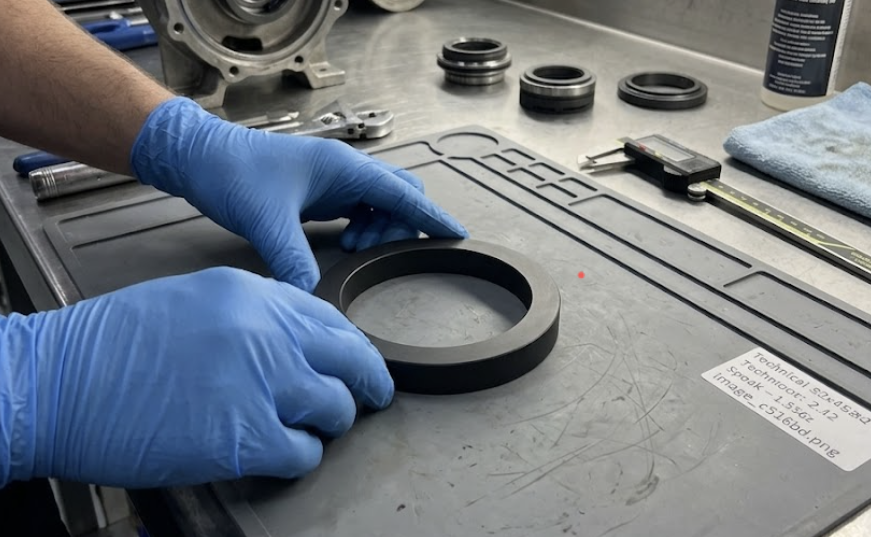
Another severe operational hazard involves localized thermal shock. When technicians execute dry-run tests without adequate fluid lubrication, friction generates extreme heat instantly. This localized thermal concentration induces severe structural tension, causing explosive thermal cracking. Therefore, maintenance crews must implement strict unboxing and handling protocols. Workers should audit each component visually under adequate lighting prior to assembly. Keeping the hard-faced rings on soft rubber pads shields them from unexpected impact shocks.
Pre-Assembly Metrology: Executing Critical Axial Runout and Shaft Deflection Audits
Precision metrology forms the foundation of any successful pump maintenance overhaul. Technicians must never slide a premium replacement seal onto an unverified shaft assembly. Instead, workers must deploy dial indicators to evaluate shaft axial float and radial runout thoroughly. Specifically, excessive radial movement forces the hard faces to shift unevenly during rotation. This irregular movement creates an asymmetric gap, allowing abrasive particles to enter the seal chamber.
Maintenance standards restrict maximum allowable radial runout to within 0.03 millimeters. If measurements exceed this tight threshold, edge-loading will destroy the brittle silicon carbide face. Furthermore, technicians must inspect the shaft sleeve for hidden bending or deep grooves. Worn internal bearings frequently cause excessive deflection, which undermines new sealing components. Therefore, crews must replace degraded bearings and worn sleeves before proceeding with seal installation. Executing these pre-assembly checks eliminates mechanical stress variables that lead to early component failure.
The Micro-Contamination Protocol: Achieving Sub-Micron Cleanliness on Hard Lapped Surfaces
Microscopic contamination represents a primary cause of immediate leakage after a pump rebuild. A single grain of atmospheric dust or metallic debris can breach the fluid barrier. When trapped between lapped faces, these foreign particles create a microscopic pathway for wastewater. Furthermore, the hard abrasive particle scores the polished ceramic surface during initial shaft rotation. Therefore, maintaining a pristine workspace remains vital throughout the installation process.
Technicians must implement a strict sub-micron cleanliness protocol for all mating faces. Workers should clean the polished surfaces using fast-evaporating, residue-free degreasing solvents. Specialized lint-free industrial wipes ensure that no fiber fragments remain on the sealing interface. Additionally, engineers must enforce a strict zero-lubricant rule for the lapped faces. Applying standard mechanical grease attracts ambient dust and prevents proper fluid film formation. Instead, technicians should apply a light film of clean system fluid or a dedicated seal assembly lubricant (compatible with elastomers) to facilitate smooth initial sliding.
Circumferential Load Balancing: Alignment and Positioning of Multi-Spring Configurations
Modern sewage pump seals frequently utilize multi-spring architectures to optimize mechanical performance. Compared to legacy single-coil designs, multi-spring setups distribute mechanical forces more evenly around the face circumference. This balanced loading maintains a parallel sealing gap even during sudden pressure fluctuations. However, achieving this balance requires precise alignment during gland installation. Technicians must tighten gland bolts progressively using a strict cross-pattern sequence.
Asymmetrical tightening cocks the seal carrier, creating uneven spring compression across the face. This misalignment leads to localized face wear and premature elastomer degradation. Furthermore, workers must verify that the dynamic seal ring moves freely along the shaft sleeve. The internal springs must compress and expand smoothly without any mechanical binding. Ensuring free axial movement allows the seal to adjust automatically to normal shaft vibrations. This precise calibration preserves parallel contact and prevents abrasive grit from bypassing the primary sealing barrier.
Material Engineering Benchmarks: The GW SEAL High-Purity Sintered Silicon Carbide (SSiC) Matrix
Industrial operators require replacement hardware that matches or exceeds original manufacturing standards. The specialized manufacturer GW SEAL addresses this demand through advanced material compounding. The firm produces high-purity Sintered Silicon Carbide faces designed to withstand extreme abrasive environments. This material matrix exhibits superior chemical inertness and exceptional thermal dissipation capabilities. Consequently, the faces remain stable when exposed to aggressive industrial chemicals and high-velocity friction.
The engineering team designs their multi-spring Grundfos Sarlin pump mechanical seals replacement line for direct drop-in interchangeability. This precise dimensional matching eliminates the need for expensive shaft modifications during field overhauls. Additionally, factory-lapping processes control surface topography to ultra-smooth metrics. Restricting surface roughness to an optimal Ra 0.05 to 0.1 micrometers reduces starting torque significantly. This smooth finish also minimizes initial frictional wear, extending the operating lifetime of wastewater pump fleets.
Institutional Risk Isolation: Factory Validation via the ISO9001 Quality Inspection Framework
Sourcing alternative components requires absolute technical certainty to protect infrastructure investments. The manufacturing enterprise GW SEAL (Ningbo Guowei Mechanical Seals Technology Co., Ltd) operates under a strict ISO9001 certified framework. This industrial discipline guarantees that every production batch undergoes rigorous non-destructive quality audits. For instance, quality control inspectors utilize monochromatic helium light bands to verify face flatness. This optical audit detects surface deviations down to fractions of a light band.
Furthermore, every assembled replacement seal undergoes comprehensive hydrostatic and vacuum testing before packaging. These rigorous pressure inspections eliminate out-of-box defects and secure field reliability. By maintaining complete material mill test certifications, the firm provides transparent traceability for corporate compliance. Procurement managers can confidently integrate these wholesale solutions into preventative maintenance programs. This rigorous factory validation minimizes operational risks and insulates water treatment plants from unexpected equipment down-time.
Conclusion: Securing Processing Continuity through Precision Installation
Standardizing precision installation steps protects heavy-duty sewage pumps from premature sealing failures. Managing material brittleness, executing runout audits, and maintaining absolute face cleanliness ensure optimal component performance. These mechanical practices allow wastewater facilities to maximize the operational lifespan of premium hard-faced seals. Transitioning to high-purity sintered silicon carbide and balanced multi-spring configurations lowers total maintenance expenditures. Ultimately, precision field execution combined with robust manufacturing quality safeguards public infrastructure continuity. Engineering teams can access full compatibility charts and technical installation support through Ningbo Guowei Mechanical Seals Technology Co., Ltd. Explore the complete range of industrial fluid isolation solutions by visiting the official corporate website at https://www.gwseal.com/.
Managing Material Brittleness: The Mechanics of Micro-Fracture Prevention in SiC Faces
Silicon carbide possesses exceptional physical hardness, making it ideal for grinding sewage environments. Nevertheless, this advanced ceramic features low fracture toughness, which makes it highly susceptible to impact damage. During field handling, minor shocks can introduce invisible sub-surface micro-cracks into the lapped ring. For example, striking the seal face with a metallic tool causes localized tensile stresses. These micro-fractures remain hidden until the pump restarts under full operational pressure. Consequently, the high mechanical load causes the crack to propagate across the sealing face rapidly.
Another severe operational hazard involves localized thermal shock. When technicians execute dry-run tests without adequate fluid lubrication, friction generates extreme heat instantly. This localized thermal concentration induces severe structural tension, causing explosive thermal cracking. Therefore, maintenance crews must implement strict unboxing and handling protocols. Workers should audit each component visually under adequate lighting prior to assembly. Keeping the hard-faced rings on soft rubber pads shields them from unexpected impact shocks.
Pre-Assembly Metrology: Executing Critical Axial Runout and Shaft Deflection Audits
Precision metrology forms the foundation of any successful pump maintenance overhaul. Technicians must never slide a premium replacement seal onto an unverified shaft assembly. Instead, workers must deploy dial indicators to evaluate shaft axial float and radial runout thoroughly. Specifically, excessive radial movement forces the hard faces to shift unevenly during rotation. This irregular movement creates an asymmetric gap, allowing abrasive particles to enter the seal chamber.
Maintenance standards restrict maximum allowable radial runout to within 0.03 millimeters. If measurements exceed this tight threshold, edge-loading will destroy the brittle silicon carbide face. Furthermore, technicians must inspect the shaft sleeve for hidden bending or deep grooves. Worn internal bearings frequently cause excessive deflection, which undermines new sealing components. Therefore, crews must replace degraded bearings and worn sleeves before proceeding with seal installation. Executing these pre-assembly checks eliminates mechanical stress variables that lead to early component failure.
The Micro-Contamination Protocol: Achieving Sub-Micron Cleanliness on Hard Lapped Surfaces
Microscopic contamination represents a primary cause of immediate leakage after a pump rebuild. A single grain of atmospheric dust or metallic debris can breach the fluid barrier. When trapped between lapped faces, these foreign particles create a microscopic pathway for wastewater. Furthermore, the hard abrasive particle scores the polished ceramic surface during initial shaft rotation. Therefore, maintaining a pristine workspace remains vital throughout the installation process.
Technicians must implement a strict sub-micron cleanliness protocol for all mating faces. Workers should clean the polished surfaces using fast-evaporating, residue-free degreasing solvents. Specialized lint-free industrial wipes ensure that no fiber fragments remain on the sealing interface. Additionally, engineers must enforce a strict zero-lubricant rule for the lapped faces. Applying standard mechanical grease attracts ambient dust and prevents proper fluid film formation. Instead, technicians should apply a light film of clean system fluid or a dedicated seal assembly lubricant (compatible with elastomers) to facilitate smooth initial sliding.
Circumferential Load Balancing: Alignment and Positioning of Multi-Spring Configurations
Modern sewage pump seals frequently utilize multi-spring architectures to optimize mechanical performance. Compared to legacy single-coil designs, multi-spring setups distribute mechanical forces more evenly around the face circumference. This balanced loading maintains a parallel sealing gap even during sudden pressure fluctuations. However, achieving this balance requires precise alignment during gland installation. Technicians must tighten gland bolts progressively using a strict cross-pattern sequence.
Asymmetrical tightening cocks the seal carrier, creating uneven spring compression across the face. This misalignment leads to localized face wear and premature elastomer degradation. Furthermore, workers must verify that the dynamic seal ring moves freely along the shaft sleeve. The internal springs must compress and expand smoothly without any mechanical binding. Ensuring free axial movement allows the seal to adjust automatically to normal shaft vibrations. This precise calibration preserves parallel contact and prevents abrasive grit from bypassing the primary sealing barrier.
Material Engineering Benchmarks: The GW SEAL High-Purity Sintered Silicon Carbide (SSiC) Matrix
Industrial operators require replacement hardware that matches or exceeds original manufacturing standards. The specialized manufacturer GW SEAL addresses this demand through advanced material compounding. The firm produces high-purity Sintered Silicon Carbide faces designed to withstand extreme abrasive environments. This material matrix exhibits superior chemical inertness and exceptional thermal dissipation capabilities. Consequently, the faces remain stable when exposed to aggressive industrial chemicals and high-velocity friction.
The engineering team designs their multi-spring Grundfos Sarlin pump mechanical seals replacement line for direct drop-in interchangeability. This precise dimensional matching eliminates the need for expensive shaft modifications during field overhauls. Additionally, factory-lapping processes control surface topography to ultra-smooth metrics. Restricting surface roughness to an optimal Ra 0.05 to 0.1 micrometers reduces starting torque significantly. This smooth finish also minimizes initial frictional wear, extending the operating lifetime of wastewater pump fleets.
Institutional Risk Isolation: Factory Validation via the ISO9001 Quality Inspection Framework
Sourcing alternative components requires absolute technical certainty to protect infrastructure investments. The manufacturing enterprise GW SEAL (Ningbo Guowei Mechanical Seals Technology Co., Ltd) operates under a strict ISO9001 certified framework. This industrial discipline guarantees that every production batch undergoes rigorous non-destructive quality audits. For instance, quality control inspectors utilize monochromatic helium light bands to verify face flatness. This optical audit detects surface deviations down to fractions of a light band.
Furthermore, every assembled replacement seal undergoes comprehensive hydrostatic and vacuum testing before packaging. These rigorous pressure inspections eliminate out-of-box defects and secure field reliability. By maintaining complete material mill test certifications, the firm provides transparent traceability for corporate compliance. Procurement managers can confidently integrate these wholesale solutions into preventative maintenance programs. This rigorous factory validation minimizes operational risks and insulates water treatment plants from unexpected equipment down-time.
Conclusion: Securing Processing Continuity through Precision Installation
Standardizing precision installation steps protects heavy-duty sewage pumps from premature sealing failures. Managing material brittleness, executing runout audits, and maintaining absolute face cleanliness ensure optimal component performance. These mechanical practices allow wastewater facilities to maximize the operational lifespan of premium hard-faced seals. Transitioning to high-purity sintered silicon carbide and balanced multi-spring configurations lowers total maintenance expenditures. Ultimately, precision field execution combined with robust manufacturing quality safeguards public infrastructure continuity. Engineering teams can access full compatibility charts and technical installation support through Ningbo Guowei Mechanical Seals Technology Co., Ltd. Explore the complete range of industrial fluid isolation solutions by visiting the official corporate website at https://www.gwseal.com/.
Ningbo Guowei Mechanical Seals Technology Co., Ltd
+ +86 574-88241891
email us here
Visit us on social media:
LinkedIn
Facebook
YouTube
Legal Disclaimer:
EIN Presswire provides this news content "as is" without warranty of any kind. We do not accept any responsibility or liability for the accuracy, content, images, videos, licenses, completeness, legality, or reliability of the information contained in this article. If you have any complaints or copyright issues related to this article, kindly contact the author above.
