

The top news stories from China
Provided by AGP
Field Observations | Research, Solutions, Method | IMARC Group
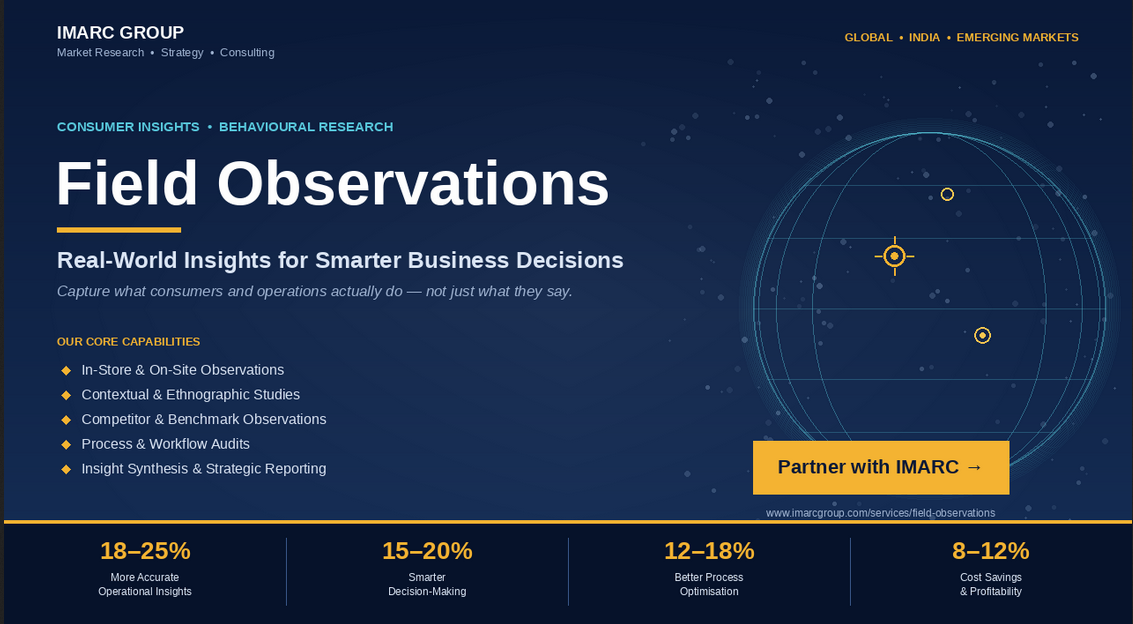
Field observations close the say-do gap and surface insights that traditional surveys, focus groups, and digital analytics consistently miss.
INDIA, May 15, 2026 /EINPresswire.com/ --For investors evaluating consumer-facing or operations-intensive businesses, field observation has emerged as a critical due-diligence and growth-strategy tool. By capturing what consumers and employees actually do — rather than what they report doing — field observations close the say-do gap and surface insights that traditional surveys, focus groups, and digital analytics consistently miss. This article examines field observation both as a research methodology and as a market opportunity for global and Indian investors.
𝐖𝐡𝐚𝐭 𝐚𝐫𝐞 𝐅𝐢𝐞𝐥𝐝 𝐎𝐛𝐬𝐞𝐫𝐯𝐚𝐭𝐢𝐨𝐧𝐬?
Field observation is a structured, evidence-based research method that captures real-world behaviour, processes, and environmental interactions in their natural setting. Unlike surveys that rely on self-reported data or focus groups that depend on memory, field observation studies record actual actions, contexts, and decision moments as they happen. The approach combines elements of cultural anthropology, human-factors engineering, and behavioural economics. At IMARC, field observation programs are designed to translate ground-level reality into board-ready strategy and investor-grade evidence.
𝐖𝐡𝐲 𝐅𝐢𝐞𝐥𝐝 𝐎𝐛𝐬𝐞𝐫𝐯𝐚𝐭𝐢𝐨𝐧𝐬 𝐀𝐫𝐞 𝐈𝐦𝐩𝐨𝐫𝐭𝐚𝐧𝐭 𝐓𝐨𝐝𝐚𝐲
Several structural shifts have made field observations indispensable to modern decision-making:
• Survey response rates have collapsed below five percent in many consumer categories, weakening traditional research.
• The experience economy now ties brand value to lived customer experience, not just product features.
• Behavioural economics has shown that intuitive System 1 decisions dominate consumption choices — these are visible only through observation.
• Post-pandemic redesign cycles across retail, healthcare, and workplaces have created fresh demand for in-context research.
• Digital analytics capture clicks but miss the physical environment in which decisions are made.
For investors, this means observation-led insights are now central to evaluating product-market fit, operational quality, and execution capability.
𝐊𝐞𝐲 𝐀𝐬𝐩𝐞𝐜𝐭𝐬 𝐨𝐟 𝐅𝐢𝐞𝐥𝐝 𝐎𝐛𝐬𝐞𝐫𝐯𝐚𝐭𝐢𝐨𝐧
Every successful field observation program rests on four foundational pillars:
• Purpose — clearly defined research objectives tied to a business or investment decision.
• Applications — chosen environments where behaviour reveals the strategic question.
• Roles — the level of observer involvement, from passive recorder to embedded participant.
• Methods — the recording, coding, and analysis frameworks used to extract insight.
𝐓𝐲𝐩𝐞𝐬 𝐨𝐟 𝐅𝐢𝐞𝐥𝐝 𝐎𝐛𝐬𝐞𝐫𝐯𝐚𝐭𝐢𝐨𝐧𝐬
Five primary observation types form the methodological backbone of the practice:
• Participant Observation — the researcher integrates into the environment to experience the context first-hand.
• Non-Participant or Passive Observation — the researcher observes without interaction, minimising influence.
• Structured Observation — predefined coding schemes capture specific behaviours for statistical analysis.
• Unstructured Observation — open-ended ethnographic notes capture emergent themes and surprises.
• Naturalistic or Covert Observation — observation in fully natural settings, governed by strict ethical protocols.
Each type is selected based on study objectives, target environment, and ethical considerations.
𝐌𝐞𝐭𝐡𝐨𝐝𝐨𝐥𝐨𝐠𝐲 𝐨𝐟 𝐅𝐢𝐞𝐥𝐝 𝐎𝐛𝐬𝐞𝐫𝐯𝐚𝐭𝐢𝐨𝐧𝐬: 𝐀 𝐒𝐭𝐞𝐩-𝐛𝐲-𝐒𝐭𝐞𝐩 𝐀𝐩𝐩𝐫𝐨𝐚𝐜𝐡
IMARC's methodology blends an enterprise engagement framework with a field-level execution protocol:
• Objective Setting & Study Design — clarify research goals, hypotheses, and sample logic.
• Define Site & Focus — select observation locations and the precise behaviours to track.
• Develop Protocol — build observation guides, coding schemes, and inter-observer calibration.
• Determine Role — decide on participant vs. non-participant approach and the ethics framework.
• Two-Stage Execution — begin with preliminary unstructured observation to surface themes, then move into structured observation with refined protocols.
• On-Site Data Collection — record behaviour using digital tools, ensuring minimal observer influence.
• Behavioural Coding & Analysis — apply thematic analysis, frequency counts, and pattern recognition.
• Insight Development & Reporting — translate findings into prioritised, decision-ready recommendations.
• Withdraw & Integrate — close fieldwork cleanly and combine findings with surveys, sales data, and digital analytics for end-to-end intelligence.
𝐂𝐨𝐫𝐞 𝐅𝐢𝐞𝐥𝐝 𝐎𝐛𝐬𝐞𝐫𝐯𝐚𝐭𝐢𝐨𝐧 𝐒𝐞𝐫𝐯𝐢𝐜𝐞𝐬
IMARC delivers field observations through five integrated service lines:
• In-Store & On-Site Observations — shopper-path analysis, queue dynamics, and operational bottleneck identification.
• Contextual & Ethnographic Studies — immersive in-home and on-location studies of daily routines and decision rituals.
• Competitor & Benchmark Observations — mystery shopping and competitive experience audits across markets.
• Process & Workflow Audits — time-motion studies, resource utilisation, and safety observations.
• Insight Synthesis & Reporting — pattern recognition, opportunity mapping, and strategic recommendations.
𝐂𝐨𝐦𝐦𝐨𝐧 𝐅𝐞𝐚𝐭𝐮𝐫𝐞𝐬 𝐨𝐟 𝐅𝐢𝐞𝐥𝐝 𝐎𝐛𝐬𝐞𝐫𝐯𝐚𝐭𝐢𝐨𝐧
Every IMARC engagement is built on four operational capabilities:
• Digital Documentation — mobile data capture and time-stamped recording.
• Structured Checklists — calibrated observation guides ensuring multi-observer consistency.
• Real-Time Reporting — phased early insights for quick decision-making.
• Data Analysis — coding, triangulation, and analytical synthesis.
𝐓𝐨𝐨𝐥𝐬, 𝐓𝐞𝐜𝐡𝐧𝐨𝐥𝐨𝐠𝐢𝐞𝐬, 𝐚𝐧𝐝 𝐃𝐚𝐭𝐚 𝐂𝐚𝐩𝐭𝐮𝐫𝐞
The modern observation stack combines human observers with technology multipliers:
• Mobile data-collection apps and digital observation forms.
• Video ethnography and wearable cameras.
• Eye-tracking and heat-mapping for visual attention analysis.
• Footfall analytics and indoor-positioning systems for path-tracking.
• AI-assisted behavioural coding and computer-vision pattern detection.
• Geo-fencing and GPS-enabled site-visit logs.
This stack converts what was once labour-intensive ethnography into a scalable, repeatable, and investor-grade service.
𝐈𝐧𝐝𝐮𝐬𝐭𝐫𝐲 𝐀𝐩𝐩𝐥𝐢𝐜𝐚𝐭𝐢𝐨𝐧𝐬 𝐨𝐟 𝐅𝐢𝐞𝐥𝐝 𝐎𝐛𝐬𝐞𝐫𝐯𝐚𝐭𝐢𝐨𝐧𝐬
Field observation studies are deployed across industries where real-world behaviour drives business outcomes:
• Retail & FMCG — shopper-path tracking, planogram effectiveness, and merchandising audits.
• Healthcare — patient-flow studies and OPD-experience audits.
• BFSI — branch-experience studies, ATM usage, and microfinance field reviews.
• Automotive — dealership experience, test-drive behaviour, and EV adoption studies.
• Food & Beverages — restaurant operations and in-home consumption rituals.
• Manufacturing — workflow optimisation, operator behaviour, and ergonomic studies.
• Agriculture — farmer scouting and rural-distribution behaviour studies.
• Technology & Media — in-context product usage and adoption studies.
• Transportation & Logistics — last-mile delivery, warehouse picking, and depot operations.
𝐁𝐞𝐧𝐞𝐟𝐢𝐭𝐬 𝐨𝐟 𝐅𝐢𝐞𝐥𝐝 𝐎𝐛𝐬𝐞𝐫𝐯𝐚𝐭𝐢𝐨𝐧𝐬
IMARC field observation programs deliver measurable business outcomes:
• 18–25% more accurate operational insights.
• 12–18% better process optimisation.
• 15–20% improved resource allocation and decision-making.
• 8–12% better customer experience and 12–15% faster response time.
• 8–12% operational cost savings and profitability uplift.
Beyond the numbers, field observations enable data-based design decisions, deeper context-of-use understanding, and authentic identification of customer pain points and operational inefficiencies.
𝐄𝐟𝐟𝐞𝐜𝐭𝐢𝐯𝐞 𝐅𝐢𝐞𝐥𝐝 𝐎𝐛𝐬𝐞𝐫𝐯𝐚𝐭𝐢𝐨𝐧: 𝐒𝐚𝐟𝐞𝐭𝐲, 𝐄𝐟𝐟𝐢𝐜𝐢𝐞𝐧𝐜𝐲, 𝐚𝐧𝐝 𝐈𝐧𝐟𝐨𝐫𝐦𝐞𝐝 𝐃𝐞𝐜𝐢𝐬𝐢𝐨𝐧𝐬
A well-designed field observation program serves three converging objectives. Safety improves because hazards, near-misses, and unsafe routines are captured at source. Efficiency improves because process bottlenecks, idle time, and resource mismatches become visible in ways that performance dashboards never reveal. Informed decision-making improves because leadership receives evidence rooted in observed reality, not in projections or self-reports. For investors, this translates into lower operational risk and stronger execution confidence in portfolio companies.
Emerging Trends in Field Observations
𝐒𝐢𝐱 𝐭𝐫𝐞𝐧𝐝𝐬 𝐚𝐫𝐞 𝐫𝐞𝐬𝐡𝐚𝐩𝐢𝐧𝐠 𝐭𝐡𝐞 𝐟𝐢𝐞𝐥𝐝-𝐨𝐛𝐬𝐞𝐫𝐯𝐚𝐭𝐢𝐨𝐧 𝐥𝐚𝐧𝐝𝐬𝐜𝐚𝐩𝐞 𝐚𝐧𝐝 𝐢𝐧𝐯𝐞𝐬𝐭𝐨𝐫 𝐨𝐩𝐩𝐨𝐫𝐭𝐮𝐧𝐢𝐭𝐲:
• AI-driven behavioural coding is collapsing analysis time from weeks to days.
• Continuous observation through always-on sensors and cameras is replacing one-off studies.
• Hybrid methodologies combine on-ground observation with digital analytics for triangulated insight.
• Omnichannel context studies track consumer behaviour across physical, digital, and quick-commerce touchpoints.
• ESG and sustainability observation captures workplace, supply-chain, and environmental behaviour.
• Vernacular and rural observation is gaining traction as brands target tier-3 and tier-4 markets and rural geographies.
𝐆𝐚𝐢𝐧 𝐑𝐞𝐚𝐥-𝐖𝐨𝐫𝐥𝐝 𝐈𝐧𝐬𝐢𝐠𝐡𝐭𝐬 𝐢𝐧𝐭𝐨 𝐂𝐨𝐧𝐬𝐮𝐦𝐞𝐫 𝐁𝐞𝐡𝐚𝐯𝐢𝐨𝐮𝐫: https://www.imarcgroup.com/services/field-observations
𝐈𝐧𝐬𝐢𝐠𝐡𝐭𝐬 𝐟𝐨𝐫 𝐆𝐥𝐨𝐛𝐚𝐥 𝐌𝐚𝐫𝐤𝐞𝐭
Field observation sits at the intersection of three fast-growing markets — the USD 96-billion global market research industry, the USD 13–17-billion behavioural-analytics segment growing at 19–28% CAGR through 2030, and the USD 58-billion computer-vision economy growing at 19.8% CAGR. The qualitative-research subsegment is expanding at roughly 7.2% CAGR — nearly double the pace of the overall research industry.
𝐆𝐫𝐨𝐰𝐭𝐡 𝐃𝐫𝐢𝐯𝐞𝐫𝐬 𝐖𝐨𝐫𝐭𝐡 𝐇𝐢𝐠𝐡𝐥𝐢𝐠𝐡𝐭𝐢𝐧𝐠
• Collapse of survey response rates pushing brands toward observed-behaviour methodologies.
• Rising CX investment across consumer and B2B categories.
• Behavioural economics moving from academia into board-level strategy.
• Post-pandemic refresh cycle across retail, healthcare, and workplace design.
• AI and computer-vision augmentation creating margin expansion in research services.
𝐑𝐞𝐠𝐢𝐨𝐧𝐚𝐥 𝐃𝐲𝐧𝐚𝐦𝐢𝐜𝐬 𝐟𝐨𝐫 𝐆𝐥𝐨𝐛𝐚𝐥 𝐀𝐥𝐥𝐨𝐜𝐚𝐭𝐢𝐨𝐧
North America commands roughly 36% of the global behavioural-analytics market and remains the dominant revenue centre. Europe is mid-growth but heavily regulated by GDPR. Asia-Pacific — led by India, China, and Southeast Asia — is the fastest-growing region. Latin America and the Middle East are emerging field-observation markets with high greenfield potential.
𝐂𝐨𝐦𝐩𝐞𝐭𝐢𝐭𝐢𝐯𝐞 𝐋𝐚𝐧𝐝𝐬𝐜𝐚𝐩𝐞: 𝐓𝐢𝐞𝐫 𝟏, 𝐓𝐢𝐞𝐫 𝟐, 𝐚𝐧𝐝 𝐓𝐢𝐞𝐫 𝟑
• Tier 1 — global insights conglomerates such as Kantar, Nielsen IQ, Ipsos, GfK, and IQVIA, offering integrated observation as part of larger contracts.
• Tier 2 — specialist boutiques in ethnography, contextual research, and behavioural design.
• Tier 3 — tech-enabled disruptors using computer vision, IoT, and AI to automate the observation layer; this tier is attracting the most venture-capital interest globally.
𝐈𝐧𝐬𝐢𝐠𝐡𝐭𝐬 𝐟𝐨𝐫 𝐈𝐧𝐝𝐢𝐚𝐧 𝐌𝐚𝐫𝐤𝐞𝐭
India is one of the most attractive growth geographies in the field-observation segment, reaching approximately USD 3.4 billion in 2025 and growing at 17–18% year-on-year — roughly five times the global research-industry growth rate. The country also serves as a global delivery hub, with 80% of Indian research revenue sourced from international clients.
𝐓𝐢𝐞𝐫 𝟏 — 𝐌𝐞𝐭𝐫𝐨 𝐂𝐢𝐭𝐢𝐞𝐬
Tier 1 anchors India's premium consumer economy and roughly 40% of organised-retail revenue. Field observation demand centres on omnichannel shopper-path studies, quick-commerce experience audits, BFSI branch optimisation, and corporate workplace ethnography. Investors gravitate here for high transaction density, mature retail formats, and rapid digital-physical convergence that enables triangulated observation.
𝐓𝐢𝐞𝐫 𝟐 — 𝐄𝐦𝐞𝐫𝐠𝐢𝐧𝐠 𝐂𝐢𝐭𝐢𝐞𝐬
Tier 2 is the fastest-growing field-observation segment. Quick commerce, branded retail, and BFSI are penetrating aggressively, fuelling demand for aspirational-consumer ethnography, dealership audits, and category-entry studies. This tier represents India's true middle-class growth engine — discretionary spending is expanding at double-digit rates, and field observation is the only reliable way to read shifting consumption rituals.
𝐓𝐢𝐞𝐫 𝟑 — 𝐒𝐦𝐚𝐥𝐥 𝐓𝐨𝐰𝐧𝐬 𝐚𝐧𝐝 𝐑𝐮𝐫𝐚𝐥 𝐈𝐧𝐝𝐢𝐚
Tier 3 covers approximately 65% of the population and remains invisible to digital-only research. Field observations are mission-critical for FMCG distribution audits, kirana retail behaviour, agritech adoption studies, microfinance field reviews, and government program evaluation. This tier offers the highest greenfield potential and sits at the heart of investor theses on rural digital adoption, vernacular commerce, and inclusive growth.
𝐖𝐡𝐲 𝐈𝐧𝐝𝐢𝐚 𝐢𝐬 𝐒𝐭𝐫𝐮𝐜𝐭𝐮𝐫𝐚𝐥𝐥𝐲 𝐂𝐨𝐦𝐩𝐞𝐥𝐥𝐢𝐧𝐠
• World's largest youth demographic with rapidly rising discretionary spending.
• Retail transformation, including quick-commerce GMV crossing USD 5–7 billion.
• 65% rural population requiring on-ground observation that digital methods cannot reach.
• 22 official languages and rich regional consumption diversity making vernacular observation essential.
• UPI-led data digitisation enabling observation-plus-transaction triangulation unique to India.
𝐒𝐞𝐜𝐭𝐨𝐫𝐚𝐥 𝐇𝐨𝐭𝐬𝐩𝐨𝐭𝐬 𝐟𝐨𝐫 𝐈𝐧𝐝𝐢𝐚 𝐅𝐢𝐞𝐥𝐝-𝐎𝐛𝐬𝐞𝐫𝐯𝐚𝐭𝐢𝐨𝐧 𝐃𝐞𝐦𝐚𝐧𝐝
• FMCG and consumer goods navigating multi-channel complexity across modern trade, kirana, and quick commerce.
• Retail and quick commerce led by Reliance Retail, Tata, DMart, Blinkit, Zepto, and Swiggy Instamart.
• BFSI through branch experience, microfinance audits, and fintech-adoption studies in tier-2/3 cities.
• Healthcare and pharma with hospital-chain experience research and field-rep-doctor interaction studies.
• Agriculture and rural through agritech firms such as DeHaat, Ninjacart, and AgroStar.
𝐈𝐧𝐝𝐢𝐚-𝐒𝐩𝐞𝐜𝐢𝐟𝐢𝐜 𝐏𝐨𝐥𝐢𝐜𝐲 𝐚𝐧𝐝 𝐑𝐞𝐠𝐮𝐥𝐚𝐭𝐨𝐫𝐲 𝐓𝐚𝐢𝐥𝐰𝐢𝐧𝐝𝐬
• Digital Personal Data Protection Act, 2023 formalising the data-privacy framework.
• Niti Aayog and World Bank commissioning large-scale public-sector observation studies.
• PLI-linked manufacturing growth driving plant-level workflow and operator-behaviour audits.
𝐃𝐨𝐦𝐞𝐬𝐭𝐢𝐜 𝐂𝐨𝐦𝐩𝐞𝐭𝐢𝐭𝐢𝐯𝐞 𝐋𝐚𝐧𝐝𝐬𝐜𝐚𝐩𝐞
Multinationals such as Kantar India, NielsenIQ India, and Ipsos India compete with Indian leaders including IMARC Group, Hansa Research, Market Xcel, Quantum Consumer Solutions, and JuxtConsult, plus a fast-growing wave of AI-led research startups offering automated observation and computer-vision analytics.
𝐄𝐭𝐡𝐢𝐜𝐬, 𝐂𝐨𝐧𝐬𝐞𝐧𝐭, 𝐚𝐧𝐝 𝐃𝐚𝐭𝐚-𝐏𝐫𝐢𝐯𝐚𝐜𝐲 𝐅𝐫𝐚𝐦𝐞𝐰𝐨𝐫𝐤
Modern field observation operates under strict ethical governance — GDPR in Europe, CCPA in California, and India's DPDP Act 2023. IMARC enforces informed consent, anonymisation protocols, IRB-equivalent ethics review, and data-retention controls to ensure both regulatory compliance and respondent dignity. This governance layer is now a non-negotiable due-diligence checkpoint for investors evaluating research-service providers.
𝐁𝐞𝐬𝐭 𝐏𝐫𝐚𝐜𝐭𝐢𝐜𝐞𝐬 𝐟𝐨𝐫 𝐄𝐟𝐟𝐞𝐜𝐭𝐢𝐯𝐞 𝐅𝐢𝐞𝐥𝐝 𝐎𝐛𝐬𝐞𝐫𝐯𝐚𝐭𝐢𝐨𝐧𝐬
The most effective programs share a common discipline:
• Define decision-oriented research questions before fieldwork begins.
• Pilot the observation guide before full deployment.
• Train and calibrate observers to ensure inter-observer reliability.
• Document context — time, place, and environmental conditions — as rigorously as behaviour.
• Mix breadth (multiple sites) with depth (repeat visits) to balance representativeness and richness.
• Triangulate findings with surveys, interviews, and digital analytics.
• Translate findings into owner-assigned, time-bound actions.
𝐓𝐡𝐞 𝐂𝐫𝐮𝐜𝐢𝐚𝐥 𝐑𝐨𝐥𝐞 𝐨𝐟 𝐅𝐢𝐥𝐞𝐝 𝐎𝐯𝐬𝐞𝐫𝐯𝐚𝐭𝐢𝐨𝐧𝐬 𝐢𝐧 𝐌𝐚𝐫𝐤𝐞𝐭 𝐑𝐞𝐬𝐞𝐚𝐫𝐜𝐡
Field observations occupy a uniquely critical position in modern market research because they capture what consumers and operations actually do — not what they remember, claim, or rationalise. While surveys quantify attitudes and focus groups surface verbalised opinions, only field observations reveal the unspoken cues, environmental influences, and System 1 decisions that shape over 90% of consumption behaviour. This makes them indispensable for closing the say-do gap that increasingly distorts self-reported data. For investors and corporate strategists, field observations validate product-market fit, expose operational inefficiencies, and convert anecdotal customer feedback into evidence-based strategy. When triangulated with surveys, digital analytics, and sales data, they deliver the highest-confidence decisions across product design, retail execution, category entry, and consumer experience. In an era of collapsing survey response rates and rising experience-economy stakes, field observations have moved from a supplementary tool to a core pillar of credible, investor-grade market research.
𝐊𝐞𝐲 𝐓𝐚𝐤𝐞𝐚𝐰𝐚𝐲𝐬
• Field observation closes the gap between what consumers say and what they do.
• Three converging markets — research, behavioural analytics, and computer vision — anchor the global investor opportunity.
• India offers a uniquely attractive 17–18% YoY growth story with a global delivery-hub leverage.
• IMARC combines methodological rigour, technology integration, and investor-grade analytical depth.
𝐖𝐡𝐲 𝐂𝐡𝐨𝐨𝐬𝐞 𝐈𝐌𝐀𝐑𝐂 𝐟𝐨𝐫 𝐅𝐢𝐞𝐥𝐝 𝐎𝐛𝐬𝐞𝐫𝐯𝐚𝐭𝐢𝐨𝐧𝐬
• Proven consulting expertise across 14+ industries and 100+ markets.
• Dedicated observation specialists and trained behavioural analysts.
• Data-led, insight-driven analytical frameworks rather than anecdotal reporting.
• Global reach combined with deep local cultural sensitivity.
• Agile, phased delivery with quick-win interim outputs.
• Long-term partnership model embedding observation into ongoing research programs.
𝗖𝗼𝗻𝘁𝗮𝗰𝘁 𝗨𝘀: https://www.imarcgroup.com/contact-us
𝗘𝗺𝗮𝗶𝗹: sales@imarcgroup.com
𝐅𝐫𝐞𝐪𝐮𝐞𝐧𝐭𝐥𝐲 𝐀𝐬𝐤𝐞𝐝 𝐐𝐮𝐞𝐬𝐭𝐢𝐨𝐧𝐬
Q1. How long does a typical field observation engagement take?
Q2. Which industries does IMARC serve for field observations?
Q3. How is success measured in field-observation engagements?
Q4. Can IMARC handle multi-country observation programs?
Q5. How does IMARC prevent observer influence on behaviour?
Q6. How are observational findings integrated with quantitative research?
Elena Anderson
IMARC Services Private Limited
+1 201-971-6302
email us here
Legal Disclaimer:
EIN Presswire provides this news content "as is" without warranty of any kind. We do not accept any responsibility or liability for the accuracy, content, images, videos, licenses, completeness, legality, or reliability of the information contained in this article. If you have any complaints or copyright issues related to this article, kindly contact the author above.
